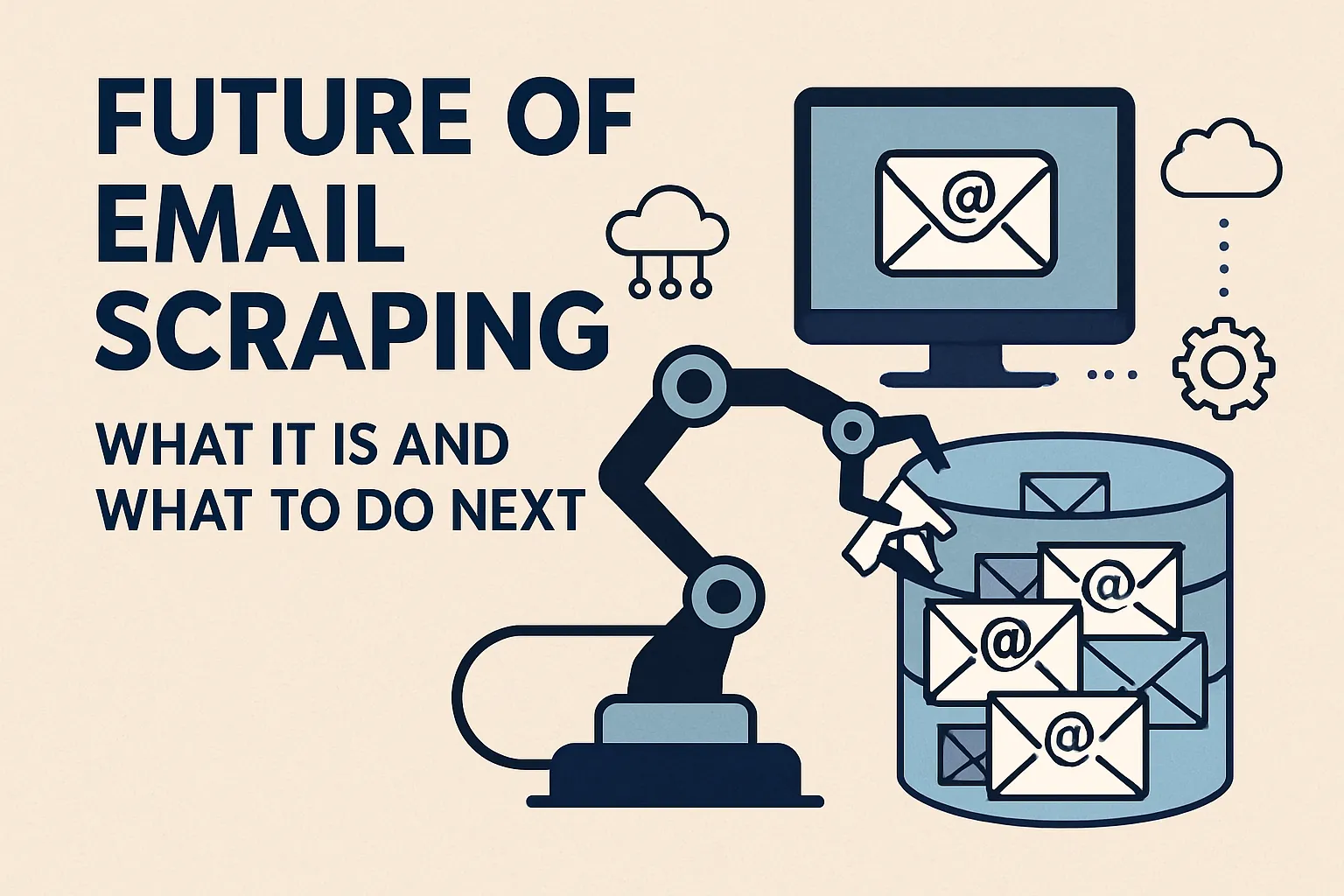

Email scraping is the automated collection of email addresses from publicly available sources online. In plain terms, it means using software or scripts to copy email contacts from websites, directories, or social media instead of gathering them manually.
A small company goes to a supplier’s website and copies the email addresses from the “Contact Us” page into a spreadsheet. With scraping tools, the same action can be repeated at scale — hundreds of sites in minutes.
Scraped lists usually underperform for a few simple reasons:
- Many addresses are old or inactive, which leads to bounced emails.
- A portion of addresses belong to spam traps, which email providers use to identify unwanted senders.
- Even if the emails are active, the people behind them never agreed to receive your messages, so engagement is low and complaints are high.
How email scraping actually works
A typical flow might look like this: a scraper visits a company’s contact page, parses the HTML to detect any strings that look like an email, deduplicates the results, verifies which addresses are valid, and exports the clean list into a CSV file. In practice, every step introduces the chance of errors, which is why scraped data always requires extra checks before it can be put to use.
The process usually follows a chain of steps:
- First, you need to discover targets — decide which pages or directories to scan.
- Then the extractor pulls out raw addresses, normalizes them into a consistent format, and removes obvious duplicates.
- After that comes validation and enrichment: checking if the email is real, still active, and sometimes adding more data like job role or company.
- Finally, the cleaned dataset is stored in a file or database, ready for use.
There are plenty of weak points along this chain. Sites built heavily on dynamic JavaScript may show no contact details to a simple crawler. CAPTCHAs and rate limits block repeated automated requests. Layout changes can break extraction rules overnight. And advanced anti-bot systems track behavior patterns — mouse movement, typing speed, or network signatures — to shut down automated scraping.
2026 trends: what’s changing and why it matters
— AI-assisted extraction and classification
AI is now used to read messy web pages, recognize contact details, and group them by role or intent. A single tool can scan a product page, pick out the marketing lead’s email, and tag it as “partnership” or “sales” even when the page uses different layouts or images.
That raises throughput: teams can collect and categorize many more contacts in a fraction of the time it used to take. The downside is accuracy. AI can grab text that looks like an address but isn’t a usable contact, or it can mislabel someone’s role, so lists need stronger verification after extraction.
— Stronger anti-scraping and behavioral defenses
Websites and platforms are deploying smarter bot detection: behavioral fingerprinting, header and TLS checks, and more aggressive CAPTCHAs. Network-level defenses are also evolving into active countermeasures that waste a scraper’s time and reveal automated behavior.
The effect is practical: scraping at scale is costlier and more fragile. Teams that try to bypass these protections face higher engineering effort, more blocked IPs, and faster breakage when defenses change.
— Privacy and consent-first expectations
Regulators and data authorities are clarifying how public contact data can be used, and privacy guidance increasingly stresses consent, purpose limitation, and documentation. In several jurisdictions, simply harvesting personal inbox addresses and using them for marketing without a lawful basis creates legal risk.
That shifts the problem from purely technical (how to collect) to procedural and legal (whether you should collect and how you document it). Teams must treat scraped data as potentially sensitive and build records or stop-use rules accordingly.
— Data marketplaces and hybrid supply
A growing market of third-party B2B datasets and API-based providers offers an alternative to raw scraping. Instead of building and maintaining brittle pipelines, teams can license curated records or call APIs that deliver structured, enriched contacts.
This reduces some technical friction and can include freshness guarantees, but it shifts choices to vendor validation and contract-level controls. For many teams, hybrid models — small targeted extraction plus licensed enrichment — are replacing large-scale blind scraping.
— A hard focus on data quality and deliverability
Buyers and inbox providers now value validated, engaged addresses over sheer volume. The market reward goes to lists that are clean, verified, and warmed before outreach.
That means more investment in verification checks, enrichment, authentication (SPF/DKIM/DMARC), and slow ramp-up of sending volume to protect reputation. In practice, a smaller but verified list often produces better response rates and fewer deliverability headaches than a large unvetted scrape.
All this means:
- Speed and scale are improving, but every address you collect will need stronger verification and legal review.
- Technical defences are rising; expect higher engineering and operational costs for scraping projects.
- Consider licensed data or hybrid approaches where quality, compliance, and deliverability matter most.
Who should consider scraping in 2026
Scraping has a bad reputation because most people link it with spam lists. But there are scenarios where it can still make sense if handled carefully and with respect for consent.
For example:
— Analysts tracking industry shifts may scrape public reports or trade directories to understand how many companies are active in a sector.
— A city government might publish contact details of local organizations, and an NGO could collect them into one file to coordinate a community program
Scraping can also support enrichment: if a business already has a consent-based list, adding missing details such as a public company domain or department email can make communication more relevant.
A simple decision signal list helps separate the “yes” from the “no”:
- Yes—emails that are published on corporate pages as business contacts, outreach based on documented legitimate interest, or datasets gathered under local consent rules.
- No—scraping private addresses, collecting without any legal basis, or ignoring regional compliance standards.
FAQ
Is email scraping legal?
It depends on where you are and how you use the data. In some regions, scraping public business contacts can be allowed if there is a legitimate interest. In others, regulators treat it as a breach of privacy law. For example, U.S. authorities like the Federal Trade Commission focus on misleading or unfair practices, while in the EU, the GDPR requires clear consent. Because the rules differ, any serious use of scraped data should be reviewed by a legal team before action.
Does scraping still work in 2026?
Yes, but with limits. Tools are more advanced, yet defenses are stronger too. The main challenge is no longer collecting emails — it’s keeping them accurate and usable. Lists are expensive to clean, many addresses fail validation, and outreach without consent risks blocking. Scraping is not “dead,” but it is no longer cheap or easy.
How do I verify scraped emails without harming deliverability?
The safest sequence is step by step. First, run addresses through a syntax and domain check to weed out obvious fakes. Then use a trusted validation service to test whether the mailbox exists. After that, start sending only to a small portion of the list and track bounce rates. This “warming” approach protects your sender reputation and avoids sudden deliverability issues.
What are fast, low-risk alternatives to scraping?
There are several ways to build usable email lists without scraping at all:
- Running gated content campaigns where people leave their email in exchange for access.
- Using opt-in forms on websites and landing pages.
- Working with verified B2B data providers that sell compliant, regularly updated datasets.
These approaches cost time or budget, but the quality is higher and the compliance risks are far lower compared to scraped contacts.
It's time to try LetsExtract (it's free)
 Click here to download the LetsExtract Email Studio
The trial version will allow you to create a contact list, check email addresses and start mailing.