
An abandoned cart happens when a shopper places items in their online basket but leaves the site without completing the order. This is common: someone adds a pair of shoes, closes the tab, and never comes back. Another customer fills the cart with groceries, gets distracted by a phone call, and forgets to pay. From a business perspective, both count as abandoned carts.
The impact is bigger than it looks. Every cart left behind means lost revenue. If 100 people start a checkout and 70 of them never finish, that is 70 potential sales gone. Each of those missed sales carries extra cost, too.
Core email chain scenarios
There is no single way to bring back abandoned carts. Different stores use different approaches depending on the size of the order, how valuable the customer is, and how much effort they want to put into email automation. In practice, several standard recovery chains are used most often.
— Single reminder
The simplest option. This works when the cart value is low or when customers usually buy quickly, like in fast-moving consumer goods. A short email with the product photo, price, and a button to return to checkout is enough to bring a part of them back.
— Two-email nudge
The first message is a reminder, and the second can strengthen the decision with social proof, such as reviews or ratings. This chain fits small to medium orders where hesitation is common but interest is still strong.
— Three-email sequence
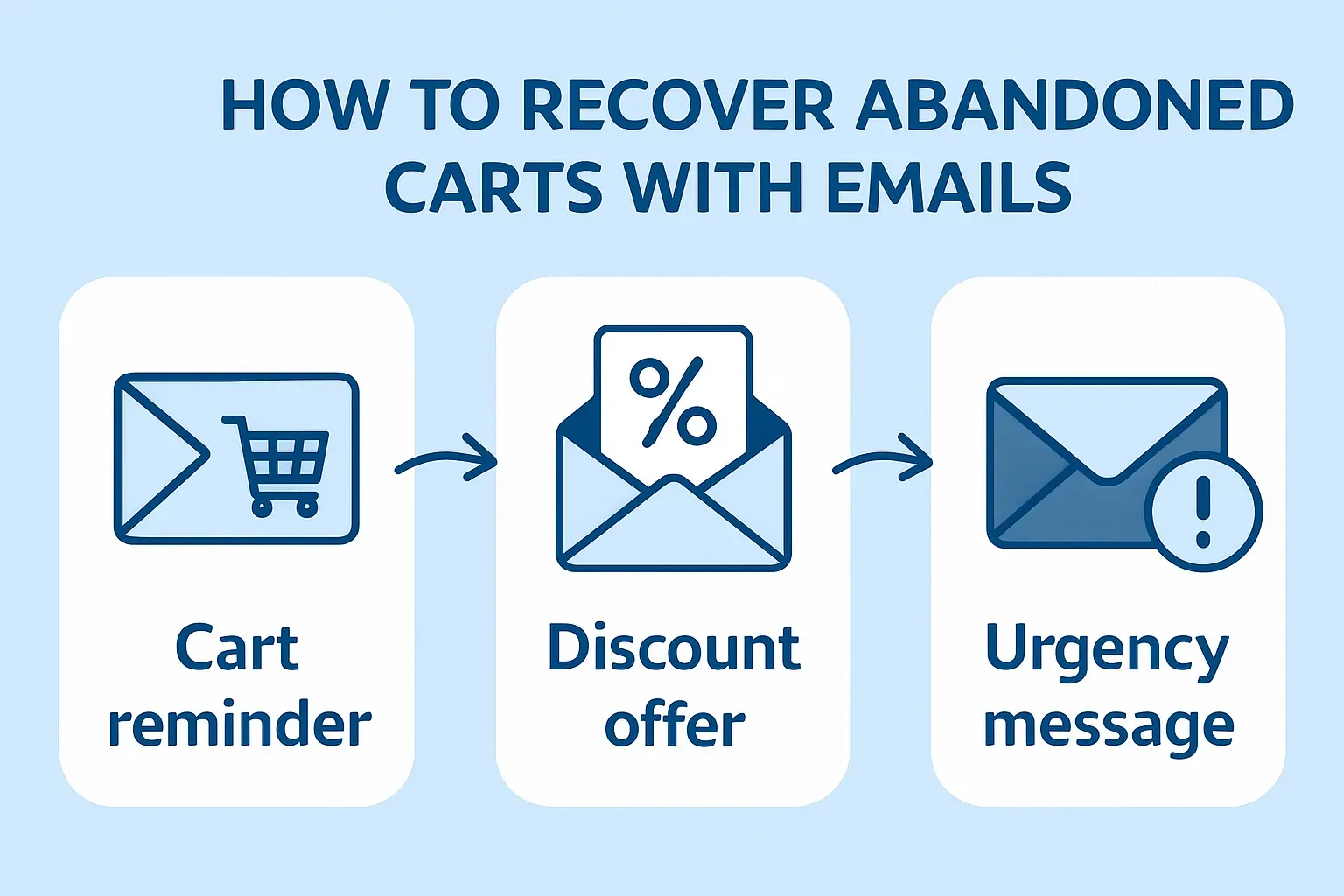
The first letter reminds the shopper about the product, the second addresses barriers like shipping or payment concerns, and the third introduces a light push — for example, highlighting limited stock or offering a small perk. This flow balances persistence and respect for the customer’s inbox and works well for average orders across many industries.
Finally, there are long-tail lifecycle campaigns. Instead of stopping after a few days, these continue for weeks with occasional reminders, tips, or related offers. They are useful for customers with high purchase potential, where the cost of ongoing communication is small compared to the possible revenue.
Scenario A — one-email quick reminder
The fastest way to recover a lost order is to send a single reminder shortly after the customer leaves the site. The right timing here is within the first hour. At this stage, the product is still fresh in the shopper’s mind, and the decision to buy has not yet faded. If you wait until the next day, the chance of bringing them back drops sharply.
The content of this email should be as simple as possible:
- Show the exact item that was left in the cart with a clear image.
- Display the price so the customer immediately remembers what they chose.
- Keep the text short, one or two lines, and include only one action button that leads straight back to checkout. This structure removes distractions and guides the customer to finish what they started.
For example, if someone added a phone case, the email could say: “You left this in your cart. Complete your order in one click.” Underneath, the picture of the phone case, its price, and a large button to return to the cart do all the work.
A single reminder works best for low-friction situations: small carts, inexpensive products, or customers who usually make quick buying decisions. If the average order value is modest, or if the buyer is unlikely to return to the site later, this simple approach gives you the highest return with the least effort.
Scenario B — two-email nudge
When a single reminder is not enough, a two-step sequence gives the customer an extra reason to come back.
- The first email
It should arrive within an hour, just like in the one-email scenario. Its role is simple: remind the shopper about the product, show the cart clearly, and provide one easy path to checkout. At this stage, you are catching people who simply got distracted and needed a quick push to finish the purchase.
- The second email
It should go out about 24 hours later. This message works differently: it adds credibility and reassurance. Many customers hesitate because they are unsure about quality or service. Here, social proof does the job. A few short customer reviews, a star rating, or a note on how many people have already bought the item can reduce doubt. If it makes sense for your product, you can also add a gentle sense of urgency — for example, a note that stock is limited or a shipping deadline is near.
Both messages should stay short and focused. A clear product image, the price, and a single call-to-action button are enough. Keep the copy conversational and light: one line to remind, one line to reassure.
For the CTA, use language that feels direct and helpful, such as “Return to your cart” or “Complete your order now.” Avoid crowding the design with multiple links or long paragraphs, because too much text weakens the effect.
This two-email flow works best for mid-range orders or products where hesitation is common but solvable. It gives customers a reason to trust their decision without overwhelming them.
Scenario C — three-email conversion-focused chain
The three-email sequence is widely used because it balances persistence with respect for the customer’s inbox. The recommended timing is to send the first email within one hour of abandonment, the second about 24 hours later, and the third around 72 hours after the cart was left.
- The first email
It’s a soft reminder. It shows the exact items left in the cart with clear images and prices, and it includes a single, prominent call-to-action button that leads directly back to checkout. The goal is simple: make it as easy as possible for the shopper to finish the purchase.
- The second email
It focuses on addressing doubts. Some customers hesitate because they are unsure about shipping costs, return policies, or payment options. This message answers those questions clearly, provides short FAQs if needed, and reinforces trust. For example, a line like “Free returns within 30 days” or “Multiple payment options accepted” can remove small barriers that otherwise stop a purchase.
- The third email
The last-chance message. At this stage, a small incentive can be included, such as free shipping or a minor discount, if it fits your margin strategy. You can also highlight scarcity, like limited stock, to motivate a decision. Keep the copy concise, focused on the key benefit, and include the same clear CTA back to the cart.
This three-step flow captures a wide range of customers: those ready to buy quickly, those needing reassurance, and those who respond to a gentle nudge or incentive.
Scenario D — four- to five-email lifecycle approach
For high-value carts, a longer email sequence works best because the customer often needs more time and reassurance before completing a purchase. The goal of this chain is to guide the shopper step by step: first remind them, then address concerns, offer incentives if needed, and finally reengage over time.
How it works:
- A typical sequence could start with a quick reminder within 30–60 minutes of abandonment.
- The second email follows after 24 hours, providing additional information such as shipping details or return policies.
- The third message, sent around three days later, can include social proof or a small incentive to reduce hesitation.
- A fourth email at seven days can highlight urgency, like low stock or limited-time shipping options.
- A fifth email, after two weeks, focuses on reengagement with tips, related products, or a final gentle offer to complete the purchase.
Discounts and incentives should be used carefully. Early emails in the chain should avoid reducing margins unnecessarily. Introduce minor perks only if earlier messages did not bring the customer back. Escalate offers gradually so the customer sees value without expecting a discount on every purchase. For example, free shipping first, then a small percentage off in later emails.
Sending too many messages can hurt deliverability or trigger complaints. To manage this, monitor engagement metrics closely. Remove unresponsive contacts after a few emails, maintain proper unsubscribe options, and keep content relevant.
Design & user experience
— Adapt everything to mobile devices
Most people check their email on a phone, so your cart recovery messages must be mobile-friendly. Use a single-column layout so content flows naturally from top to bottom. Make the main call-to-action button large enough to tap easily, and ensure product images load quickly and remain sharp on small screens.
— Visual hierarchy is important
The product image should be the first element the customer sees. Right below it, display the price clearly. Place the CTA immediately after these elements so the path to checkout is obvious. Supporting details, like shipping information or return policies, can appear below the CTA. This order keeps the focus on what drives action while still providing helpful context.
— Accessibility should not be overlooked
Add alt text for images so screen readers can describe the product. Use font sizes that are easy to read on small screens, and check contrast between text and background to make sure every line is legible.
— Call-to-action buttons need careful attention
Use concise text like “Return to Cart” or “Complete Your Order.” Place the button prominently near the product image and price. Include a text link as a fallback for users whose email clients block images or buttons. These small design choices ensure that more customers can complete their purchase without technical barriers, increasing the overall recovery rate.
Cross-channel recovery
Using multiple channels can increase the chances of recovering abandoned carts, but coordination is key. Timing should be aligned so that emails, SMS, and push notifications do not overlap in a way that feels spammy.
Make sure every message is sent only to customers who have given consent for that channel. For instance, an email might go first as a gentle reminder, followed by an SMS to high-intent shoppers who have left high-value items in the cart.
On-site tactics add another layer of recovery. Exit overlays can appear when a visitor tries to leave the site, offering a reminder or a small incentive.
Cart reminder banners can stay visible while the customer continues browsing. Saved-cart emails triggered by a cart save action ensure that even if the shopper leaves, the system captures the items and can remind them later.
Measuring results across these channels can be tricky. A single purchase may be influenced by multiple touchpoints, so it is important to track each interaction carefully. Use clear attribution windows and avoid double-counting recovered orders.
FAQ
How long after abandonment should I email?
Send the first email within the first hour. This is when the product is fresh in the customer’s mind. Follow-up messages can come at 24 hours and 72 hours, depending on the sequence you choose. Early reminders capture immediate interest, while later messages address hesitation.
Should I offer a discount?
Use discounts carefully. Early emails should focus on reminders and information. Introduce a small incentive only if previous messages did not bring the customer back. For example, free shipping in the third email can encourage completion without cutting too deeply into margins.
How many emails are too many?
Most shoppers respond within three to five emails. Exceeding this can increase complaints and unsubscribes. Monitor engagement and remove unresponsive contacts from long sequences to maintain deliverability and relevance.
How do I measure recovered revenue?
Track the orders that result directly from your cart recovery emails. Compare the recovered sales to abandoned carts to calculate a recovery rate. Consider using attribution windows to decide which channel or email triggered the final purchase. This gives a clear picture of the campaign’s impact.
It's time to try LetsExtract (it's free)
 Click here to download the LetsExtract Email Studio
The trial version will allow you to create a contact list, check email addresses and start mailing.