
Most teams treat inactive contacts as a lost cause: they stop opening emails, stop clicking, and quietly sit in the database. Over time, this turns into a hidden cost: you keep paying for traffic and new leads, while people who already know your brand bring no value.
Re-engagement campaigns fix that. They give you a structured way to bring people back into the conversation and turn old contacts into revenue again.
Who should receive a win-back email and when
The first step is to define what “inactive” means for your business. Inactivity is a period when a person stops showing any meaningful action. That action can be different depending on the model: opening emails, clicking links, making purchases, visiting the site, or using a product. For example:
- No email opens or clicks for 60–90 days in a regular newsletter flow.
- No purchases within one full buying cycle (for example, 3 months for fast-moving products or 12 months for high-ticket items).
- No product usage or logins for a defined period in a SaaS product.
A daily deals service will react much faster than a company that sells enterprise software. You need to align the timing with real customer behavior.
Not every inactive contact should be your first priority. It is more effective to start with groups that already showed strong intent:
- past buyers who have not returned;
- leads who requested a demo or pricing but went silent;
- trial users who did not convert;
- customers with high previous value who stopped engaging.
These people already know your product and have interacted with your business. A well-timed email can remind them why they came in the first place and give them a reason to return.
The 7 re-engagement campaign ideas
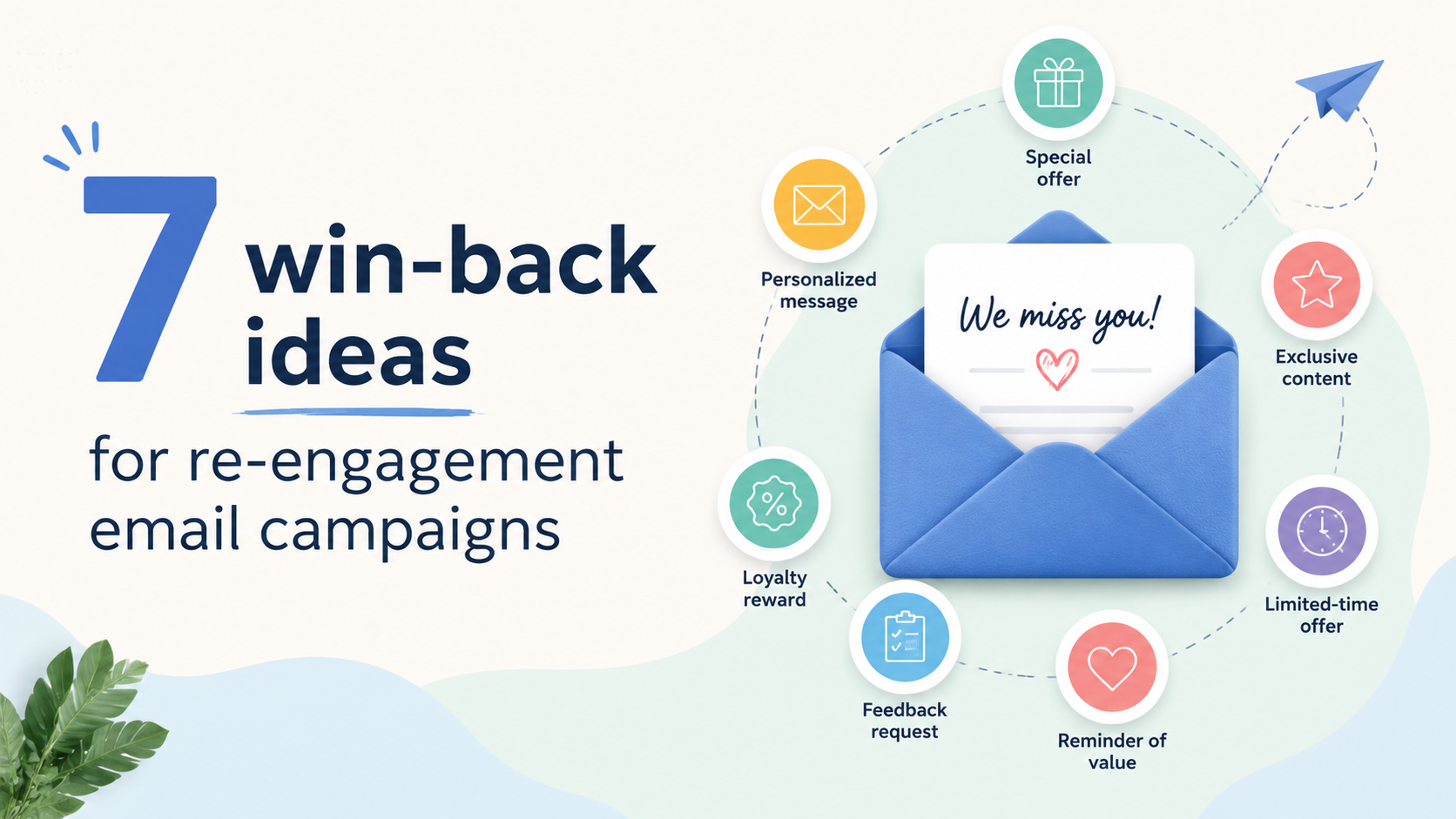
Re-engagement works best when you match the message to the situation. Below are seven practical approaches, each with its own logic, tone, and expected outcome.
— “We miss you” check-in
The message is calm and low-pressure: you acknowledge that the person has been inactive and gently invite them back. It works well for subscribers who used to engage but faded out without a clear reason. For example, a newsletter that someone opened every week suddenly goes quiet. A short email like “We haven’t seen you in a while — still interested?” with a clear button to return often brings part of the audience back.
Avoid this approach if the contact has been inactive for a very long time with no prior engagement. In that case, the message feels too generic. The expected response is moderate: you will not win back everyone, but you will quickly identify who is still interested.
— Product or service update
Here the focus is on what changed. You give the person a reason to look again: new features, updated pricing, improved delivery, or a broader ассортимент. This works well for SaaS products, online services, and stores with frequent updates. For instance, a user tried a tool six months ago and left. If the product has improved since then, a clear “What’s new since you last visited” email can restart interest.
This approach is weak if nothing meaningful has changed. In that case, the email feels empty. The response is usually stronger than a simple check-in, because it gives a concrete reason to return.
— Incentive-based win-back
This is a direct offer: discount, bonus, free shipping, or extended trial. It works when price or risk may have been a barrier. For example, an online store can send “Here’s 15% off your next order — valid for 3 days” to customers who bought once and never returned.
Use this carefully. If you rely on discounts too often, people start waiting for them and ignore regular emails. It also does not work well for audiences that never showed purchase intent. The response is usually quick and measurable, but it may not build long-term engagement.
— Feedback or exit survey
Instead of pushing a sale, you ask a simple question: “What went wrong?” or “Why did you stop using the product?” This works well when you need to understand churn. A service company, for example, may send a one-question survey to users who stopped logging in.
This approach will not bring immediate revenue, but it gives valuable insights. Avoid making the survey long or complicated. The expected response rate is lower, but the quality of feedback is high.
— Personalized recommendation
You use past behavior to suggest something relevant. If a customer bought running shoes, you show new arrivals in the same category. If a user read certain articles, you send similar content. This works well when you have clean data and clear patterns.
If the data is messy or incomplete, the recommendations can miss the mark and reduce trust. This is where having structured data matters. If information is spread across tools, solutions like LetsExtract can help collect and prepare it so recommendations are based on real behavior.
— Value-first content reactivation
Instead of selling, you give something useful: a guide, checklist, or short training. For example, a B2B company can send a practical guide that solves a small problem the audience faces. This lowers resistance and rebuilds trust.
This works well for audiences that are not ready to buy or were never very active. It is less effective if the content is generic or does not solve a clear problem. The response is slower, but it builds long-term engagement.
— Final check-in or preference update
You ask directly whether the person wants to stay in touch and offer options: continue receiving emails, reduce frequency, or unsubscribe. For example, “Do you still want to hear from us? Choose what works for you.”
This helps clean the list and protect deliverability. It should not be used as a first message, because it closes the conversation too early. The response is clear: people either re-engage or leave, which makes future campaigns more effective.
Example of a re-engagement email
Subject line: Still working on your projects?
Preview text: A quick update and a small bonus if you want to return
Hi Alex,
We noticed you haven’t been active lately, so we wanted to check in.
Over the past few months, we’ve updated the dashboard and added a few features that make daily tasks faster. If you stopped using the service because it felt slow or limited, it’s worth taking another look.
To make it easier, we’ve added 7 extra days to your account. No setup needed — just log in and continue where you left off.
CTA: Go back to your account
If this is no longer relevant, you can update your email preferences here or unsubscribe in one click.
Thanks for your time,
{your name & company}
This email works because it is direct and easy to process: it starts with a clear reason for the message and explains what changed, so the reader understands why it is worth returning. There is only one action to take, so the decision is simple.
This structure can be reused across different businesses. You can replace the update, the incentive, or the action, but the logic stays the same: explain why you are writing, show value, and make the next step clear.
FAQ
What is a re-engagement email campaign?
It is a series of emails sent to people who stopped interacting with your business. The goal is to bring them back, understand why they became inactive, or clean the list if they are no longer interested.
How many emails should a win-back sequence contain?
In most cases, 2 to 4 emails are enough. One message rarely changes behavior, while long sequences feel intrusive. For example, you can start with a check-in, follow with an update or offer, and finish with a final confirmation.
When is the right time to send a reactivation email?
When there is a clear gap in activity. This can be 60–90 days without email engagement or one full purchase cycle without a transaction. The timing should reflect how often your customers usually interact with you.
What metrics should I watch first?
Start with open rate and click rate to see if people notice and interact with your emails. Then look at conversions, such as purchases or logins. Also track unsubscribes and spam complaints to avoid negative impact.
Should I archive or delete silent contacts?
You do not need to delete them immediately. It is better to move them out of active campaigns into a separate segment. This keeps your main list clean while preserving data in case you need it later. If contacts stay inactive for a long time, removal becomes reasonable.
It's time to try LetsExtract (it's free)
 Click here to download the LetsExtract Email Studio
The trial version will allow you to create a contact list, check email addresses and start mailing.