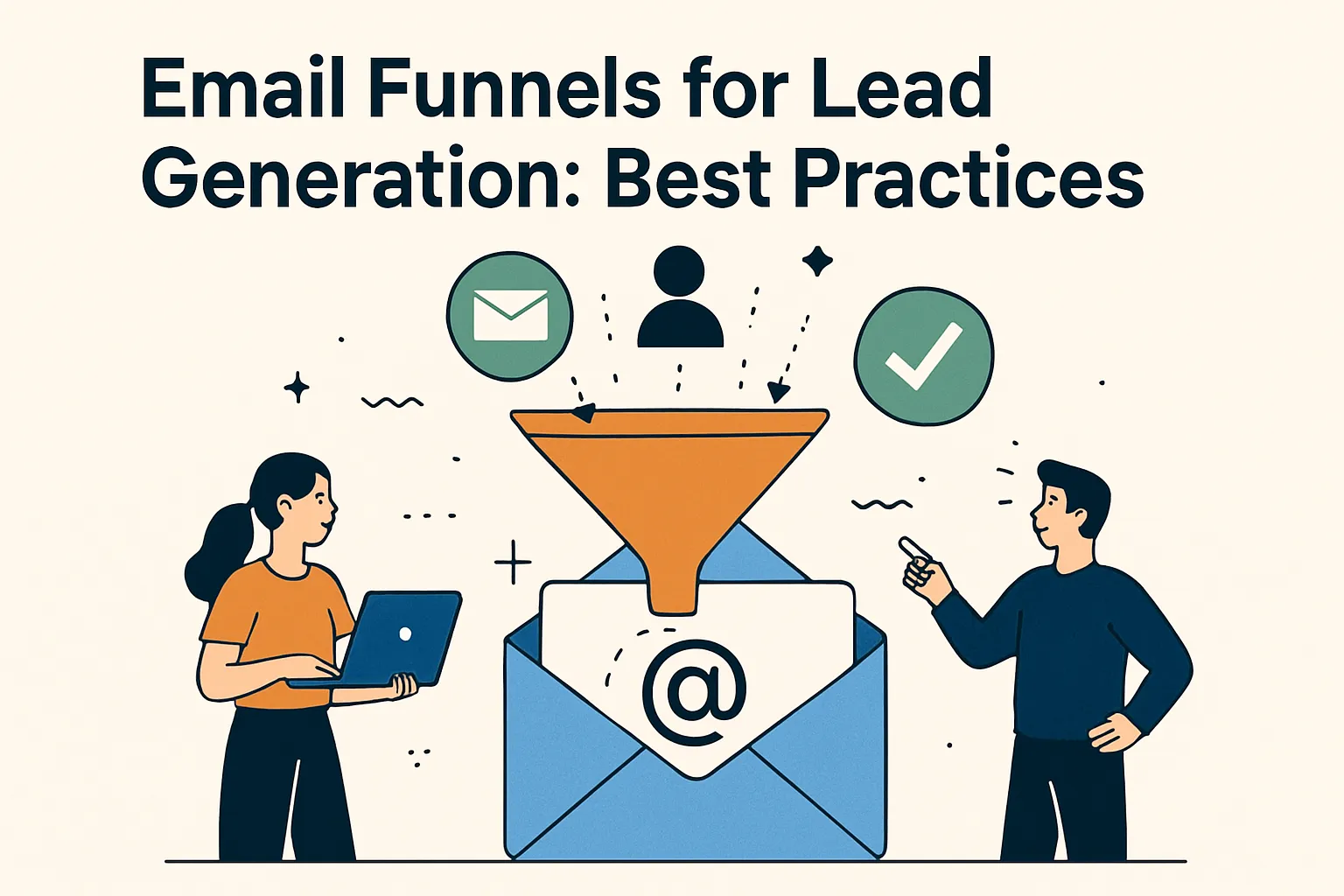

An email funnel is a structured sequence of emails that guides a potential customer from first interest to purchase. Each email has a clear role — to move the person one step closer to making a decision.
Funnel stages explained
An email funnel works in stages. Each stage has a clear goal and its own type of message.
1. Top of the funnel (TOFU)
This is where attention is captured. A person at this stage knows little about your product. They are just exploring. The goal here is to offer something useful in exchange for an email address — a free checklist, short course, calculator, or trend report.
The simpler and more practical the offer, the higher the signup rate. The signup process itself should take seconds: a short form, clear privacy notice, and one click to confirm. A small software business, for example, can use a free “ROI calculator” as a lead magnet. It solves a quick problem for the visitor and opens the door to a future conversation.
2. Middle of the funnel (MOFU)
Here the person already knows who you are. Now the task is to build trust. These emails teach, explain, and show proof that your product or service works. Educational content works best — short guides, client stories, or clear answers to common questions
For instance, after downloading the ROI calculator, the lead might receive two or three emails explaining how companies use these numbers to plan their budgets. Each message brings value and shows expertise.
At this point, you can also start segmenting: people who click on “budget planning” may be more interested in financial tools, while those who click on “marketing ROI” lean toward analytics. Segmentation helps send the next emails that match their interests instead of generic newsletters.
3. Bottom of the funnel (BOFU)
The person has seen your content and understands what you offer. Now the goal is to help them take action — start a free trial, book a demo, or schedule a consultation. The tone changes from educational to practical. The email focuses on the benefit of acting now.
For example, “Book a 20-minute demo to see how your data flows directly into your dashboard.” This is also where marketing hands the lead over to sales, with all the relevant details: what the person downloaded, what they clicked, what questions they asked.
Lead capture and list-building best practice
A good email funnel starts with a good list — people who genuinely want to hear from you. Buying addresses or scraping random emails is tempting but short-sighted.
The right approach is to attract people who choose to join, because what you offer solves a real problem for them. Here are the method: a lead magnet — something useful enough that a visitor is willing to share an email address in return.
The content should be quick to use and directly tied to what your company does. In retail, it can be a short style guide or a discount on the first purchase. In consulting, it might be a five-step business checklist. In software, it could be a calculator that shows how much time automation saves per week. Small training videos or short PDF playbooks also work well. The key is to make the lead magnet specific: one problem, one solution, one clear benefit.
Once you have the magnet, make it easy to access:
- The signup form should be visible but not intrusive — placed near relevant content or at the end of a helpful article. Keep the form short.
- At the start, ask only for an email and a first name. Later, as trust grows, you can collect more information through progressive profiling — adding one or two extra fields in follow-up forms, such as company size or role.
- Be honest about what happens after someone signs up. The incentive you offer creates an expectation, and you need to meet it.
- Every form should also include clear opt-in language. State what the person is agreeing to — for example: “By signing up, you’ll receive one email per week with marketing insights and updates. You can unsubscribe anytime.” Add a link to your privacy policy next to the button.
Who to email and when
Segmentation helps you talk to each group in a way that fits their level of interest. It also keeps your list healthy and your message relevant. There are two main ways to segment contacts.
— Rule-based segmentation
This means dividing the list by simple criteria such as job title, industry, or company size. For example, a software provider can create one group for small businesses and another for enterprises. Each group then receives emails with examples and pricing that make sense for them. Rule-based segments are easy to start with, and they help you avoid sending irrelevant content that clutters inboxes.
— Behavior-triggered segmentation
Here, the system reacts to what the person does. If someone clicks on a product link or downloads a case study, they are clearly interested in that topic. If they haven’t opened an email in a month, they might be losing interest.
These behaviors give strong signals about where the lead stands in the funnel. A simple automation rule can move them to a “high intent” group or, if inactive, to a re-engagement sequence. For instance, if a contact watches a short product demo, they could automatically receive a follow-up email offering a trial.
Segmentation becomes even more precise when you add lead scoring — a way to measure how ready a contact is to buy.
Each action gets a value. Opening an email might add 5 points, clicking a link adds 10, filling out a form adds 20. Negative points are assigned for inactivity, such as not opening any emails for several weeks. Over time, the score reflects the lead’s engagement and intent.
Once you have scores, you can tie them to clear actions:
- Leads with high scores can be passed to sales with a short note: “This contact engaged with three product emails and requested a demo.”
- Mid-level scores can trigger entry into a bottom-of-the-funnel (BOFU) email series — focused on conversion offers.
- Low scores, or those dropping over time, should move to a “cool down” list that receives lighter, educational content or a check-in survey.
When segmentation and scoring work together, every message goes out with purpose. The right people get the right content at the right time.
Legal & privacy checklist for email funnels
Design your funnel so it respects people’s rights and keeps your business out of trouble. The basic legal requirements are straightforward: get clear permission when required, let people unsubscribe easily, identify who is sending the message, and keep simple records that prove consent.
In the EU and UK this often means documented, affirmative consent; in the U.S. you must give clear opt-out instructions and accurate sender information under CAN-SPAM.
Decide default behavior by geography:
— If a contact is in the EU (or under UK rules), treat the signup as requiring explicit consent for marketing. That means a clear opt-in checkbox and a recorded timestamp tied to the exact signup form.
— For U.S. contacts, you can rely on an opt-out model under CAN-SPAM, but you still must include a working unsubscribe link, a valid sender address, and avoid deceptive headers or subject lines. When you apply stricter rules (for example, opt-in everywhere), you reduce risk and simplify operations.
Keep the records you need to show how and when consent was given. Store this information with each contact so you can answer questions quickly and prove compliance in an audit. Typical required items to keep are:
- email address
- date/time of signup
- the exact signup form or version used
- what the user consented to (marketing types/frequency)
- source (web page, campaign, import)
- proof of any confirmation (double opt-in); and any later withdrawal or unsubscribes
Keep these in a secure, searchable place and keep an audit trail of changes.
Practical checklist to implement today:
- Use explicit opt-in language on forms.
- Add a privacy-policy link next to the signup button.
- Store the consent timestamp and form version with each contact.
- Make unsubscribe one click from every marketing email.
- Keep a searchable log of DSARs and consent withdrawals.
These steps protect your customers and make audits simple to handle.
It's time to try LetsExtract (it's free)
 Click here to download the LetsExtract Email Studio
The trial version will allow you to create a contact list, check email addresses and start mailing.
Related posts:
 Best strategies to boost your website traffic
 Why ESET NOD32 Is the Worst Antivirus and Why You Should Never Use It
 Omnichannel marketing: how to combine email, SMS, push & social
 Why you shouldn’t buy email lists for your campaigns — risks, laws & better alternatives
 Email marketing analytics: key KPIs & tools
 Subscriber segmentation for CRM: strategies, examples & metrics
