
Traditional email marketing was built around volume and repetition: send more campaigns, remind more often, stay visible in the inbox.
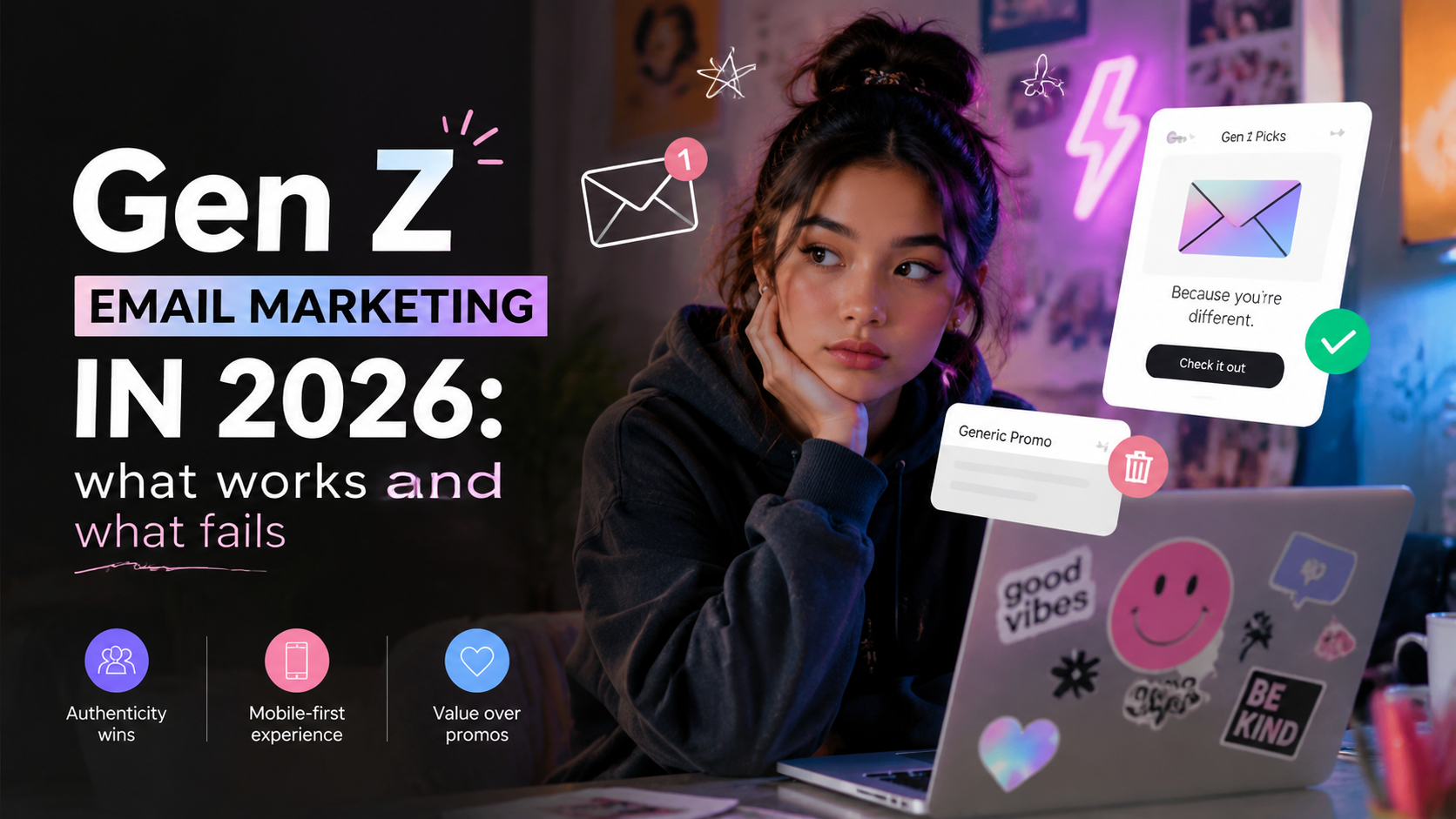
Gen Z changes that logic. This audience does not read email the way older segments do: they scan and open a message on a phone, look at it for a few seconds, and decide very quickly if it is worth their time. If the email feels generic, too long, or unclear, they move on without a second thought. There is no patience for warming up the reader with long introductions.
The core difference is this: traditional email marketing focuses on frequency, Gen Z email marketing focuses on relevance.
Who Gen Z is in email marketing terms
In marketing discussions, Gen Z is often defined by age. For email, age is the least useful starting point.
What matters is behavior. Gen Z grew up with smartphones, fast apps, and constant content. Because of that, they process information quickly and filter aggressively. In practice, this shows up in a few patterns:
— Reading email on mobile by default
A message is opened between other tasks, often in short breaks during the day. This means the email has to be easy to grasp at a glance. If the main point is not visible right away, it is missed.
— Scanning instead of reading
A subject line, a few words in the first screen, and a quick look at the layout — that is often all the time you get. For example, a long paragraph explaining a product rarely works. A short line with a clear benefit and a visible button works better because it fits how they consume content.
— Quick noticing a weak relevance
If the email does not match their interest, they ignore it. This is why broad campaigns underperform with this audience. A person who subscribed for one type of content will not engage with something unrelated, even if the offer is strong.
— Sensitivity to tone
Overly polished or corporate language creates distance. At the same time, forced attempts to sound young create distrust. A neutral, clear tone works best just because it feels closer to how people actually communicate.
Two people of the same age can react very differently to the same email. But patterns like mobile reading, fast scanning, and low tolerance for irrelevant content are consistent enough to guide how campaigns are built.
What traditional email marketing gets wrong with Gen Z
Traditional campaigns often begin with long introductions. The email opens with background, context, or brand messaging, and only later gets to the point.
For Gen Z, this structure does not work. If the value is not clear in the first seconds, the email is closed. A message that starts with “We are excited to share…” and takes three paragraphs to explain the offer loses attention before the offer even appears.
The same happens with inflated promises:
— Phrases like “exclusive opportunity” or “limited-time offer you can’t miss” are used so often that they stop carrying meaning.
— A short and specific line like “20% off items you viewed yesterday” is easier to understand and more likely to get a click.
Language is another weak point. Corporate phrasing creates distance. When a reader feels that the email could have been sent to anyone, they treat it that way.
For example, “Dear valued customer” signals right away that the message is generic. A simple “Hi” with a clear next line about why the email matters works better.
There is also a mismatch between classic newsletter logic and how Gen Z consumes content. Newsletters were designed as long, content-heavy emails that cover many topics at once. Gen Z prefers one clear idea per message. When an email tries to include updates, articles, promotions, and announcements all at once, it becomes harder to process. The reader scans, does not find a clear next step, and leaves.
All these issues lead to the same result: the email feels like background noise. The problem is not the channel itself, it is that the format has not adapted to how this audience reads and decides.
What Gen Z expects from brand emails in 2026
1. Clarity
The reader should understand what the email is about without effort. The subject line sets the direction, and the first screen confirms it. If a person opens an email expecting one thing and sees something else, trust drops immediately. For example, if the subject line обещает a guide and the email turns into a sales pitch, the next email from that sender is less likely to be opened.
2. Usefulness
Gen Z asks a simple question: “Is this worth my time?” The answer has to be visible right away. A message that helps solve a small problem, saves time, or points to something relevant has value. A message that talks about the brand without helping the reader does not.
3. Speed
The email should load fast, read fast, and lead to action fast. This affects both copy and design. Short paragraphs, clear buttons, and a visible structure make it easier to act. When the path from opening to clicking is obvious, engagement grows.
4. Design
Clean layout, enough space between elements, and a strong visual hierarchy help the reader scan the message. A simple layout with one main action performs better because it reduces choice.
The relationship with the brand begins at the moment of subscription. If the signup form is too complex, asks for too much data, or does not explain what the user will receive, it creates doubt.
5. Respect & trust
When emails arrive at a reasonable pace, match the promised content, and respect the reader’s time, the brand becomes predictable in a good way. If the tone suddenly changes or the content feels random, trust breaks quickly.
6. Tone
Brands should sound like people. It means writing in a clear, direct way. A line like “Here are three updates you might find useful this week” feels natural. It is easy to read and easy to understand.
These expectations can be summarized simply:
- clear message from the first line;
- immediate value for the reader;
- fast and easy interaction on mobile;
- clean and predictable design;
- honest tone without templates or filler.
Content formats that work better with Gen Z
Gen Z responds better to emails that are easy to understand and easy to act on. The format matters as much as the offer itself.
— Short, practical formats
This works best. A quick update about something new, a short list of useful tips, a product drop, or a reminder about something the user already showed interest in — these are easy to process. For example, an ecommerce brand can send a short email with “New items in your saved category” and show three products with clear buttons. There is no need for a long introduction. The value is clear at a glance.
— Educational content
It works well when it helps solve a small, real problem. This is especially true for services and B2B. A company that offers analytics tools can send a short email like “3 ways to clean your contact list before your next campaign.” The reader gets immediate value, even if they do not buy anything right away. This builds trust and keeps the brand relevant between sales cycles.
— Direct promotion
Still works, but it needs to be precise. A general “big sale” email often performs worse than a targeted offer tied to behavior. For example, a reminder about an abandoned cart or a price drop on a viewed item feels more useful because it connects to something the user already did.
— Social proof
It helps reduce doubt, but it should be used carefully. A short line like “Most users choose this option” or a brief customer quote can support a decision. Long blocks of testimonials usually do not get read. The same applies to user-generated content. One or two real photos or short reviews can add credibility. Too many elements create noise.
— Limited-time offers
They can drive action, but only if they are used honestly. If every email says “last chance,” the urgency disappears. When a real deadline is clear and used occasionally, it works better. The reader starts to trust that timing matters.
— Interactive elements
A quick poll, a one-click feedback button, or a short rating request can increase engagement. For example, after a purchase, a brand can send “Was this helpful?” with two buttons. It is fast to answer and gives the brand useful data. Complex interactive features often slow the email down and reduce clarity.
Let’s summarize:
- One email — one idea — one action.
- Connect the message to what the user already did.
- Use proof and urgency carefully.
- Keep formats short and easy to scan.
FAQ
How is Gen Z different from Millennials in email marketing?
Gen Z is faster in decision-making and less tolerant of weak relevance. Millennials are more willing to read longer emails if the topic is interesting. Gen Z expects the value to be clear immediately. If the first screen does not answer “why this matters,” the email is closed.
Does email still work for Gen Z, or should brands focus on other channels?
Email still works, but the approach has to change. It is no longer a channel for long, generic newsletters. It works as a channel for direct, relevant messages tied to user actions. When email is treated this way, it supports both engagement and sales.
What metrics matter most in 2026?
Open rate is no longer enough on its own. It shows that the subject line worked, but not that the email created value. It is more useful to look at clicks, conversions, replies, and unsubscribe rates. These metrics show what happens after the open and help evaluate real impact.
Do you need complex segmentation to work with Gen Z?
No. Even simple segmentation makes a big difference. Separating new subscribers from active customers, or engaged users from inactive ones, already improves relevance. The goal is not complexity. The goal is to avoid sending the same message to everyone.
How can you prepare and manage contact data for better segmentation?
Clean and structured data is the starting point. If contacts are duplicated, outdated, or mixed without clear tags, segmentation becomes harder. Tools like LetsExtract can help gather and organize contact data before campaigns are built. This reduces errors and makes targeting more precise.
It's time to try LetsExtract (it's free)
 Click here to download the LetsExtract Email Studio
The trial version will allow you to create a contact list, check email addresses and start mailing.