
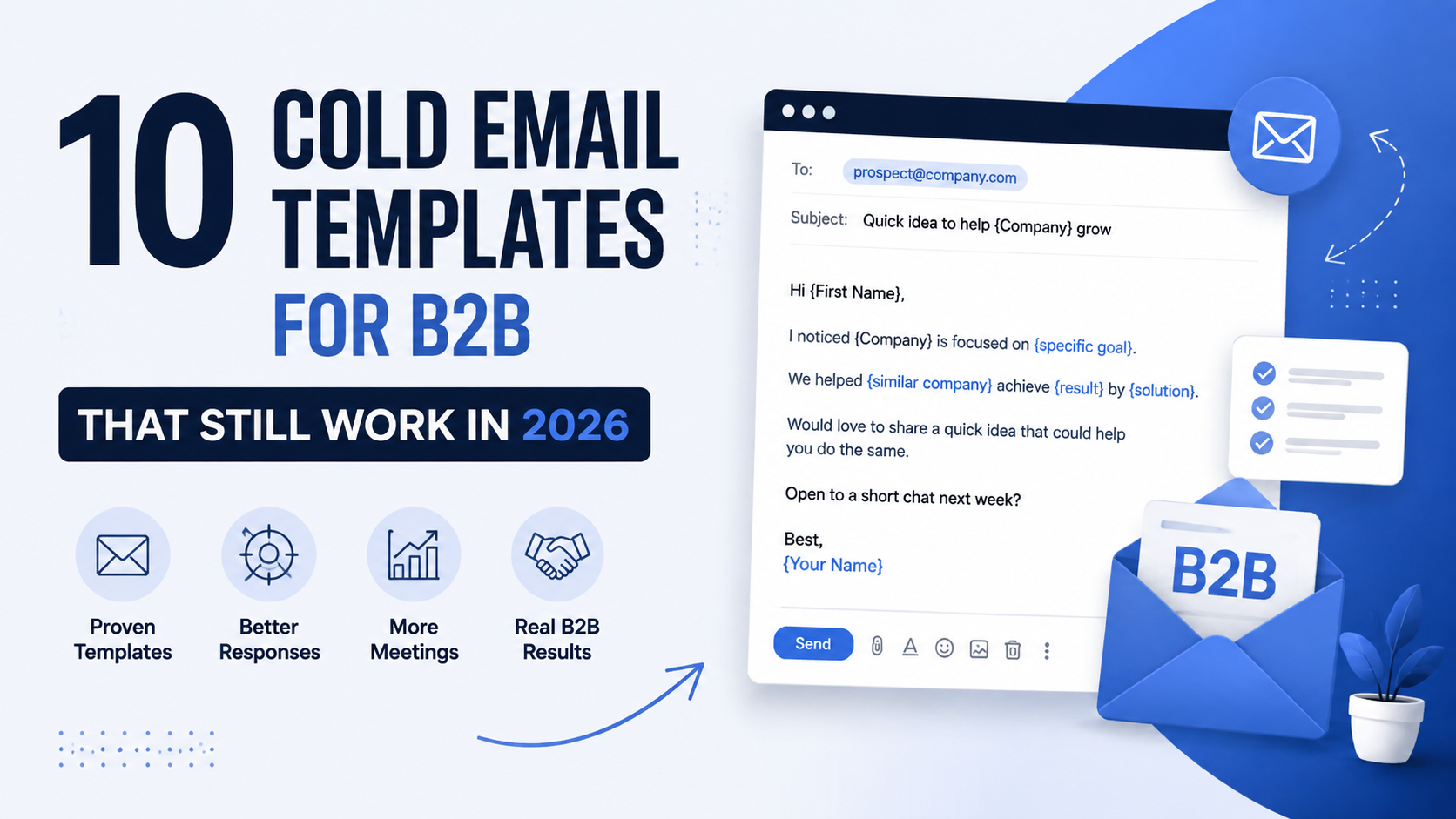

A cold email is a message you send to a person who does not know you yet. In B2B sales, cold email is one of the ways to start conversations with potential clients. It sits at the very top of the funnel: before calls, demos and deals — there is a first touch.
Are cold emails still relevant in 2026?
Cold emails still work in 2026 but only when they are targeted. The old approach of sending the same message to thousands of people is losing effectiveness. Several things changed:
— Inbox filters became stricter
Email providers are better at spotting mass outreach patterns. If the list is messy or the message looks like spam, the email may not even reach the main inbox.
— Expectations went up
Decision-makers are used to receiving outreach. They scan emails fast and decide in seconds if it is worth reading. If the message does not connect to their situation, they move on.
— Relevance became the main filter
A cold email is no longer judged by how polished it sounds. It is judged by how well it matches the recipient’s current reality.
This is why generic outreach does not work well anymore. It ignores context and assumes that one message fits everyone. At the same time, cold email still has clear advantages when done right:
- It gives direct access to decision-makers without waiting for inbound interest.
- It is easy to test: you can change subject lines, messages, and segments and see what works.
- It scales: once you find a working approach, you can apply it to similar segments.
The 10 cold email templates for B2B sales
You should treat these templates as starting points. The structure stays the same, but the details change depending on who you write to, what is happening in their business, and what you offer.
Each template answers a simple question: why are you writing to this person right now? Here are the use cases we cover:
- Pain-point email — when you know a common problem in the segment.
- Trigger-based email — when something just changed in the company.
- Role-based email — when you tailor the message to a job title.
- Problem-agitation-light email — when you want to highlight a gap without pressure.
- Social-proof email — when you rely on results from similar companies.
- Value-first email — when you give something useful upfront.
- Referral or shared context email — when you have a weak warm angle.
- Alternative approach email — when the prospect likely uses another solution.
- Follow-up email — when there was no reply.
- Re-engagement email — when the conversation went cold.
Pain-point email
This is one of the simplest and most reliable formats. You write to a person because they likely have a specific problem. Use this template when you work with a clear segment and know their typical issues. It fits sales teams, marketing teams, operations leads — any role where problems repeat across companies.
| Hi Alex,Many B2B teams we speak with struggle with low reply rates from cold outreach, even when volume is high.In most cases, the issue is not the offer, but targeting and message structure. We recently worked with a mid-sized team that improved replies after adjusting these two points.Would it make sense to share what exactly changed?— Jerry, {position and company} |
Trigger-based email
This template works when something just changed in the company. You react to a real signal: hiring, funding, expansion, a new product, a visible shift in strategy.
Use this template when you can clearly link your message to a recent event. It works well in fast-moving segments where companies often change something — for example, when teams grow or launch new directions.
| Hi Alex,Saw that your team is actively hiring SDRs. At this stage, many companies run into the same issue — more outreach, but not more replies.We recently helped a team in a similar situation adjust their targeting and email structure, which improved response rates without increasing volume.Want me to share what they changed?— Jerry, {position and company} |
Role-based email
The same offer should be explained differently depending on who reads the email. A sales director, a marketer, and a founder look at the same problem from different angles.
Use this template when your product or service touches several departments. You keep the core idea the same, but adjust the language and focus.
For a commercial role, the message can sound like this:
| Hi Alex,Many sales teams reach a point where activity grows, but meetings do not. The issue is often in targeting and first-touch messaging.We recently worked with a B2B team that improved meeting rates after tightening these two areas, without increasing volume.Worth a quick discussion to see if this applies to your team?— Jerry, {position and company} |
For a marketing role, the same idea shifts slightly:
| Hi Alex,Many marketing teams generate leads, but conversion into conversations stays low. Often the gap is in how outreach is structured after the lead enters the pipeline.We helped a team improve this stage by aligning messaging with segment and intent, which increased response rates.Would it make sense to walk through what changed?— Jerry, {position and company} |
Problem-agitation-light email
This template is close to the pain-point email, but with a softer tone. You create a small amount of tension, enough to catch attention, without sounding aggressive.
Use this format when the problem may exist, but you are not fully sure. It works well when you want to start a conversation, not push for a quick decision.
| Hi Alex,In many B2B teams, outreach volume grows over time, but the quality of conversations does not always follow. This usually happens when targeting and messaging drift apart.We have seen teams fix this by making small adjustments to how they segment contacts and structure first emails.Does this sound familiar, or is this already under control on your side?— Jerry, {position and company} |
Social-proof email
This template relies on proof. You show that similar companies faced a similar situation and achieved a result. Use this format when you have clear outcomes: more replies, more meetings, time saved, or a cleaner process. Numbers and concrete results make the message easier to trust.
| Hi Alex,We recently worked with a mid-market SaaS team that struggled with low reply rates despite high outreach volume.After adjusting targeting and simplifying their email structure, they increased responses by around 25% within a few weeks.Happy to share what exactly changed if this is relevant on your side.— Jerry, {position and company} |
What matters here is the type of proof. Focus on outcomes that connect to business value: time saved, meetings booked, response rate growth, or a clearer process. Avoid vague claims like “we helped companies grow”, they do not add meaning.
Value-first email
You give the reader a small piece of value before asking for anything. It can be an insight, a short checklist, a benchmark, or a practical idea they can apply.
This works well when the prospect is not actively looking for a solution. A direct pitch at this stage often gets ignored. A useful idea is easier to accept because it does not require a decision.
| Hi Alex,One small thing we often see in B2B outreach — emails try to cover too much at once. When teams reduce each message to one clear idea, reply rates usually improve.If your first email has more than one ask or more than one key point, it is worth simplifying. If helpful, I can share a short checklist we use to review outbound messages.— Jerry, {position and company} |
Referral or mutual connection email
This template uses a shared context. It can be a referral from a colleague, a mention from a partner, or a brief interaction at an event. The goal is to make the email feel familiar without overstating the relationship. If you push the connection too hard, it starts to feel artificial.
| Hi Alex,We briefly crossed paths at a recent industry event, and your colleague mentioned that your team is working on improving outbound processes.We have been helping teams in a similar position simplify their targeting and first-touch emails, which often leads to more consistent replies.Happy to continue the conversation if this is still relevant on your side.— Jerry, {position and company} |
Competitor or alternative approach email
This works best when the prospect is already evaluating options or facing limitations in their current setup. At this stage, they are more open to comparisons.
The tone must stay neutral. Avoid attacking competitors or criticizing the current solution. Focus on the process and the outcome.
| Hi Alex,Many teams handle outbound by increasing volume when replies drop. This works for a while, but often leads to lower quality conversations over time.Another approach is to reduce volume and focus on tighter segmentation and simpler messaging. Teams that switch to this model often see more consistent responses with less effort.Would it make sense to compare how these approaches perform in practice?— Jerry, {position and company} |
Follow-up email after no reply
No reply does not always mean “no.” In most cases, it means the email was not a priority at that moment: people miss messages, postpone them, or forget to respond.
The key rule is do not repeat the same email. If you send the same text again, it adds no value. Each follow-up should move the conversation forward, even a little.
| Hi Alex,Just wanted to follow up on my previous note.One thing worth adding — many teams see better replies after simplifying the first email to one clear point instead of several.Would it make sense to share a quick example, or should I close this for now?— Jerry, {position and company} |
Re-engagement email
Re-engagement emails are used when there was contact before, but the conversation stopped. This can happen after a call, a demo, or a short exchange that did not continue.
The situation is different from a cold email because the person already knows you, but something paused the process: it may be timing, priorities, or internal changes.
| Hi Alex,We spoke a while ago about improving outbound processes, but the conversation paused.Just wanted to check if this is still relevant, or if priorities have shifted on your side.Happy to reconnect if timing is better now.— Jerry, {position and company} |
FAQ
Is cold email legal?
Yes, but you need to follow basic rules. You should have a valid business reason to contact the person, use accurate data, and give a way to opt out. The exact requirements depend on the region, but the principle is simple: be transparent and respectful.
How many emails should I send?
It is better to send 50–100 well-targeted emails than 1,000 generic ones. Once you see what works, you can increase volume carefully.
How long should a cold email be?
Short. In most cases, 5–8 lines are enough. The reader should understand the point in a few seconds.
How many follow-ups should I send?
Usually 2–3 follow-ups after the first email. More can feel excessive unless there is a strong reason to continue.
What reply rate should I expect?
It depends on targeting and message quality. In practice, even a small percentage can be valuable if the audience is well chosen. Focus on positive replies, not just total replies.
Can I automate cold email?
Yes, but automation should support your process, not replace thinking. You can automate sending and follow-ups, but the list and the message still need to be relevant.
It's time to try LetsExtract (it's free)
 Click here to download the LetsExtract Email Studio
The trial version will allow you to create a contact list, check email addresses and start mailing.
Related posts:
 Top 9 email scrapers & finders for 2026 — and what to choose
 SMTP verification: how it works & why it matters for deliverability
 Email marketing: why it still works in 2026 and how to get started
 Collect emails from LinkedIn legally: tools & best practices for marketers
 How to build email marketing for SaaS
 7 win-back ideas for re-engagement email campaigns
